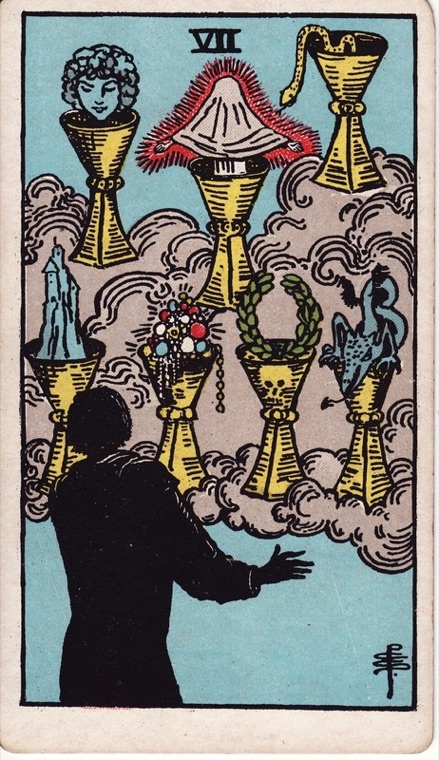
A silhouetted figure on a high platform faces seven floating cups holding jewels, snakes, and a veiled face.
Seven of Cups
Upright
Seven cups float on clouds, each holding a treasure: castles, jewels, dragons, a veiled figure. The Seven of Cups is the dizzy abundance of options — careers, lovers, versions of yourself — all glittering, most untested. Dreams are fuel, but a wish you never touch is just a nicer kind of hiding. Pick one cup. A real choice will feel heavier than a fantasy, and that weight is how you know it is real.
Reversed
The clouds are thinning and the fog of too many options is finally burning off. Reversed, the Seven of Cups means clarity is arriving: you are dropping the fantasies that were never yours and choosing the path that is. Trust the plainer option. The one that survives daylight, not the one that shines brightest, is the one worth walking.
Where is this energy showing up in your life right now?
Why this card looks like this
The painting is not decoration — every object in it is doing a job.
A figure reduced to a silhouette stands on a high platform facing seven cups, each one holding a different treasure, and some of those treasures are snakes and human heads. The platform gives the seer height and therefore distance, the silhouette denies them an identity so they become whoever is currently dreaming, and the seven cups are seven separate containers for desire. Snakes inside cups mean a want that has grown a body of its own, and heads mean a wish that has quietly acquired a face.
The seventh cup does not hold treasure at all but a shrouded head in profile, and it is the only one of the seven that is not an object, which quietly says the deepest want here is a person or a face rather than a thing. And the cups float without any visible support while the figure stands on a solid platform, so the fantasies are the unstable part of the picture and the dreamer is the only fixed thing in it.
Use the height of the platform as the question: from where are you looking at this, and has anyone told you that a distance is being called a plan? Then ask which cup they have actually chosen, because the card always has one that is the serpent, and ask whose face is hiding in the last one, since the figure only looks and never reaches, so a reading here should end with a choice, not with a description.